You can change your surname (geslachtsnaam) in the Netherlands only on one of the grounds set out in a government decree, and the procedure runs through Justis, not through the court. Preference alone is not enough, and a divorce is not a ground either: in those cases the answer usually lies in the name you use, not in a formal name change.
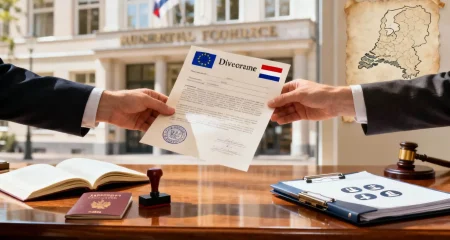
Under article 1:7 of the Dutch Civil Code (BW), the King can change a person’s surname at their request or at the request of their legal representative. Justis, the screening authority of the Ministry of Justice and Security, assesses the application. If Justis approves it, the change takes effect by royal decree (Koninklijk Besluit). The grounds are listed in the Surname Change Decree (Besluit geslachtsnaamswijziging), and they are narrower than most applicants expect.
On what grounds can you change your surname?
Your application must fit one of the grounds in the decree. The general grounds in article 1 of the decree cover a name that is clearly indecent or ridiculous, a name so common that it does not sufficiently distinguish you, and a few specific situations about spelling and origin.
The general grounds are:
- the name is clearly indecent or ridiculous, on its own or in connection with your profession, social position or personal circumstances;
- the name is so common that it has too little distinguishing value;
- the name is non-Dutch and you acquired Dutch nationality through naturalisation or a similar procedure;
- the name was spelled incorrectly in the past and you have used the correct spelling since;
- your family previously bore a Frisian name, or a Frisian name was recorded in Dutch spelling.
Where a change is granted on one of these grounds, the decree prefers a small adjustment, such as changing a few letters or adding a prefix or suffix. Only if that does not work is another surname chosen, for example the name of a parent.
Justis also handles other types of request. These include a change for descendants of enslaved persons and a change because your surname causes serious psychological distress. For the last route, the decree requires you to show that keeping the name would seriously harm your physical or mental health. In practice this means supporting evidence, such as a statement from a professional.
Can you give a child the surname of the parent who raises them?
Yes, in many cases. The decree contains a separate ground for minors who have been cared for and raised for a continuous period by a parent who does not pass on their surname, by that parent’s partner or by foster parents. The required period is at least three years, or at least five years if the child is under 12.
The application must be made jointly by the child’s legal representative and the person whose surname the child is to receive. A child aged 12 or older must agree with the change. If the other parent refuses consent, the application is in principle rejected. For a child of 12 or older, the application can still succeed if the child maintains their consent.
For a child under 12, a refusal by the other parent is decisive, except in two situations. The first is where that parent has been irrevocably convicted of certain serious offences against the child. The second is where that parent and the child lived together as a family for no more than a quarter of the period before the required period of care. A child’s surname can be changed on this ground only once.
Does marriage or divorce change your surname?
No. Marrying in the Netherlands does not alter your legal surname. Under article 1:9 BW, you gain the right to use your spouse’s surname, on its own or combined with your own. You can register that choice of name use with your municipality.
After a divorce you may in principle continue to use your former spouse’s name. The court can withdraw that right at the request of the former spouse, but only where there are good reasons (gegronde redenen). So if your question is simply which name appears on your post and in the municipal records, it is a registration matter with the municipality, not a name change.
절차는 어떻게 진행되나요?
You submit the application to Justis with evidence supporting the ground you rely on, and you pay a fee. Justis contacts other people who are important for the decision, such as the other parent of your child. If the application is approved, your name changes by royal decree.
According to Justis, the fee is €835 for one adult or for one or two children under 18, and €1,670 for three or more children. You always pay the fee, also if the application is refused or withdrawn. Justis states that you usually receive a decision within 20 weeks. Where another parent is involved and objects, the process can take longer.
신청이 거부되면 어떻게 해야 하나요?
You can lodge an objection (bezwaar) within six weeks of the decision. If the objection is rejected, you can appeal to the administrative court. An objection is most useful where you can add evidence or show that your situation does fit one of the grounds.
Is a change of first name a different procedure?
Yes. Under article 1:4 BW, the district court (rechtbank) decides on a change of first name, at the request of the person concerned or their legal representative. You need a lawyer for that petition, and the court looks at whether you have a sufficiently weighty interest. See our article on 이름 변경하기.
결론
- A surname change is decided by royal decree after an assessment by Justis, not by a court.
- Your application must fit a ground in the Surname Change Decree; preference alone is not enough.
- For a child, a change to the name of the parent who raises them requires three years of care, or five years under age 12, and usually the other parent’s consent.
- Marriage and divorce affect only the name you use, which you register with the municipality.
- The fee is €835 (€1,670 for three or more children), and the decision usually takes up to 20 weeks.
자주하는 질문
이혼 후 아이의 성을 제 성으로 바꿀 수 있나요?
Possibly, on the care ground, once your child has lived with you for the required period: three years, or five years if your child is under 12. The other parent’s position matters. If they refuse consent, the application is in principle rejected, subject to the exceptions in the decree.
단순히 다른 성을 선호한다는 이유로 성을 바꿀 수 있나요?
No. Your application must fall within one of the grounds in the decree, or you must show that keeping the name would seriously harm your health.
Do I get the fee back if my application is refused?
No. According to Justis, you always pay the application fee, whatever the outcome.
이름은 바꾸기가 더 쉬울까요?
It is a different route rather than an easier one: a court petition through a lawyer, on the test of a sufficiently weighty interest.
현재 상황이 어떤지 잘 모르시겠나요? 상황을 알려주시면 영업일 기준 하루 이내에 가능한 해결책을 안내해 드리겠습니다.
방법 Law & More 이에 대해 저희가 어떻게 도움을 드릴 수 있는지 자세히 설명드리겠습니다. 가족 변호사 페이지를 확인하시기 바랍니다.